

One of the most misunderstood gifts of the Holy Spirit is tongues.
Christians disagree about what it is, whether the gift still operates today, and, if it is still valid, how to use it in church. The New Testament gives important guidance, but it does not answer every question.
The first mention of tongues appears in a disputed passage in Mark’s gospel. Here Jesus, speaking to his disciples after his resurrection, is quoted as saying:
And these signs will accompany those who believe: In my name they will drive out demons; they will speak in new tongues; Mark 16:17
Since the earliest manuscripts of Mark do not include verses 9-20 of Mark 16, we need to look elsewhere for an understanding of the gift of tongues.
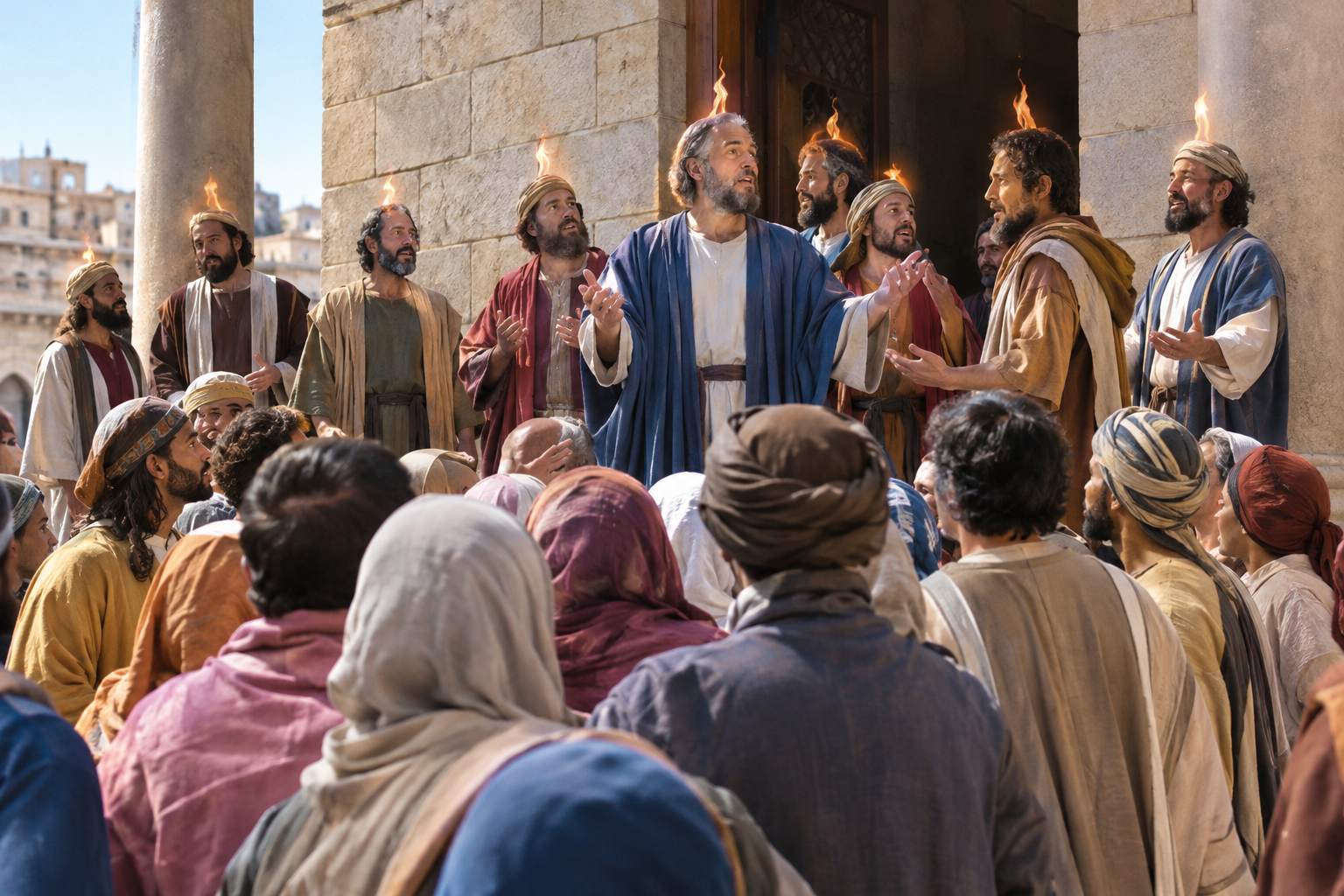
The best-known outpouring of the gift of tongues takes place in Jerusalem during the Jewish feast of Pentecost, fifty days after Jesus’ resurrection. In Acts of the Apostles, we read:
When the day of Pentecost came, they (the closest followers of Jesus) were all together in one place. Suddenly a sound like the blowing of a violent wind came from heaven and filled the whole house where they were sitting. They saw what seemed to be tongues of fire that separated and came to rest on each of them. All of them were filled with the Holy Spirit and began to speak in other tongues as the Spirit enabled them.
Now there were staying in Jerusalem God-fearing Jews from every nation under heaven. When they heard this sound, a crowd came together in bewilderment, because each one heard their own language being spoken. Acts 2:1-6
Since that day, there are no other documented instances of believers spontaneously speaking the good news of Jesus in languages they neither studied nor previously spoke, resulting in the conversion of those who understand that language and are persuaded to repent and accept God’s gift of grace. That’s why many Christian scholars say that the Gift of Tongues was given to launch the church in the first century but is no longer active today.
Paul, however, speaks of tongues as a gift that is given to some as a way of edifying the church. In his letter to the Greek church in Corinth, Paul writes:
Now to each one the manifestation of the Spirit is given for the common good. To one there is given through the Spirit a message of wisdom, to another a message of knowledge by means of the same Spirit, to another faith by the same Spirit, to another gifts of healing by that one Spirit, to another miraculous powers, to another prophecy, to another distinguishing between spirits, to another speaking in different kinds of tongues,and to still another the interpretation of tongues. All these are the work of one and the same Spirit, and he distributes them to each one, just as he determines. 1 Corinthians 12:7–11
Paul explains that the gifts serve one body: no single member has them all, and each is meant to benefit others. Later in this letter, he clarifies the importance of intelligibility in worship. The first 25 verses of Chapter 14 focus on the gift of tongues and its interpretation in the context of edifying the body of Christ. Paul summarizes he instruction on this matter this way:
When you come together, each of you has a hymn, or a word of instruction, a revelation, a tongue or an interpretation. Everything must be done so that the church may be built up. If anyone speaks in a tongue, two—or at the most three—should speak, one at a time, and someone must interpret. If there is no interpreter, the speaker should keep quiet in the church and speak to himself and to God. 1 Corinthians 14:26–28
The gift of interpretation completes the public use of tongues: one person speaks, another makes the message understandable, and the gathered church can respond and be built up. Paul’s guiding principle is love expressed through intelligibility and order. In whatever way tongues are understood, spiritual gifts find their proper purpose when they serve the body of Christ.
Christians have read the above passages in different ways. John Chrysostom, a fourth-century bishop, understood tongues as Spirit-given human languages, recalling speakers of Persian, Latin, and other tongues. Augustine later described Pentecost’s many languages as a sign of the Church’s mission among all nations. Reformation writer John Calvin likewise treated tongues as miraculous language gifts and distinguished speaking a language from interpreting it. These writers differ in emphasis, but all connect the gift with the Spirit’s work and the Church’s life.
Modern charismatic Christians commonly understand tongues as continuing today, often as Spirit-prompted prayer or praise that may not be understood by the speaker or listeners. They point to Paul’s discussion of prayer “in a tongue” and his instruction to seek interpretation so the church can be edified. Unfortunately, in many charismatic churches there seems to be an overemphasis on speaking in tongues as a sign that someone is Spirit-filled.
No biblical basis or sound teaching supports the idea that there are two tiers of Christians: those filled with the Spirit, as evidenced by their ability to “speak in tongues,” and those not filled with the Spirit because they do not speak in tongues. In fact, drawing that distinction has caused a great rift in the greater body of Christ and weakens the very Gospel that should be uniting Christians.
Paul describes a parallel expression of the work of the Holy Spirit in his letter to the church in Rome. When believers do not know how to pray, “the Spirit himself intercedes for us through wordless groans.” Romans 8:26
Paul does not identify these groanings as tongues or describe them as spoken messages that require interpretation. They express the Spirit’s help in weakness, even when a believer cannot put the need into words.
To answer the question, what is the Gift of Tongues? There are two clear answers. One is a unique gift bestowed on the Apostles at Pentecost when men delivered the gospel message in languages they had not studied or previously spoken. The other is a gift to some to speak in a congregational setting words that most attendees do not understand, but that someone with the gift of interpretation can explain.
Spiritual gifts like the gift of tongues help the church work together as the body of Christ, carrying on His mission on earth. One day that mission will be finished, and Christ will call his church home. If you would like to be part of the church God will one day call home, we encourage you to read our post: How Can I Become a Christian?
_______________________
If you would like to learn more about the gifts of the Spirit, we suggest you to pick up our 32-page booklet, Reflections on the Gifts and Fruit of the Holy Spirit.