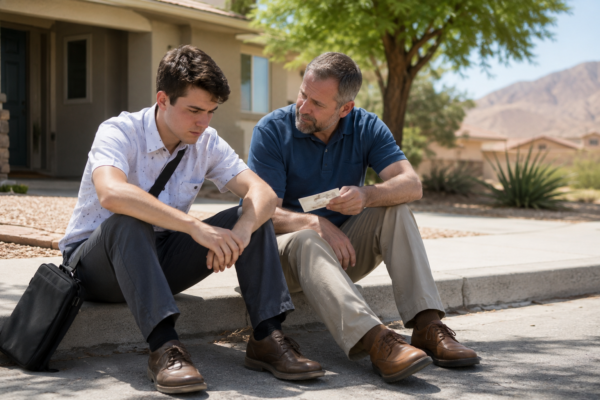

Sixty years ago, I was working as a door-to-door salesman in a community on the edge of the Mojave Desert. Waiting to get picked up at the end of a discouraging day, a pastor from the house I had just visited walked out and sat with me at the curb. He offered some much-needed words of encouragement and handed me a card on which was written a poem about not giving up. Those moments on the hot, dusty curb, and the poem that I subsequently memorized, inspired me to become a top performer.
He may not have thought about it at the time, but that pastor had the Gift of Encouragement that the Apostle Paul wrote about in his letter to the Church in Rome:
We have different gifts, according to the grace given to each of us. If your gift is prophesying, then prophesy in accordance with your faith; if it is serving, then serve; if it is teaching, then teach; if it is to encourage, then give encouragement; if it is giving, then give generously; if it is to lead, do it diligently; if it is to show mercy, do it cheerfully. Romans 12:6-8
What does it mean to encourage someone?
Paul uses the the Greek word paraklesis which carries the ideas of encouragement, comfort, exhortation, and coming alongside another person. At its simplest, encouragement is giving another person courage to keep going. It is seeing possibility where someone else sees failure, offering hope when circumstances seem hopeless, and sometimes standing beside someone when everyone else has walked away.
In Acts 4:36 we read about a man called Joseph of Cyprus being given the name Barnabas which in Hebrew means “Son of Encouragement”.
Barnabas demonstrated the gift in remarkable ways. When the Christians in Jerusalem were suspicious of the newly converted Saul, Barnabas took him to the apostles and testified on his behalf (Acts 9:26–27).
Later, when Gentiles began coming to Christ in Antioch, Barnabas did not respond with suspicion. He “was glad and encouraged them all to remain true to the Lord” (Acts 11:23). His encouragement helped create an environment in which the church flourished.
The Old Testament also reveals the power of encouragement. Moses struggled with his ability to speak, yet God provided Aaron to stand beside him (Exodus 4:10–16). Jewish commentary has noted that Aaron’s role was not simply to speak for Moses but to bridge the gap between Moses’ sense of inadequacy and the task God had given him.
The New Testament turns encouragement into a responsibility for every believer: “Encourage one another and build each other up” (1 Thessalonians 5:11). Hebrews says we should “encourage one another daily” (Hebrews 3:13). Encouragement, therefore, is not merely a personality trait. For some, it is a particular spiritual gift; for all Christians, it is a biblical calling.
The importance of encouragement reaches far beyond the church. A parent who tells a discouraged child, “I believe you can do this,” may change that child’s future. A teacher who sees potential in a struggling student may keep that student from giving up. A supervisor who recognizes the abilities of a young employee can give that person confidence to accept responsibility rather than retreat in fear. And when young people encounter failure in school, disappointment in relationships, or the uncertainty of entering the workforce, a timely word of encouragement can become a turning point.
Throughout history men and women exhibited the gift of encouragment in amazing ways. Many know of Helen Keller the blind and deaf girl who many thought was incapable of learning. One teacher, Anne Sullivan, refused to give up on Helen when others could not reach her. Through persistent teaching, patience, and belief in Keller’s potential, Sullivan helped unlock a mind that would eventually influence millions.
The greatest lesson of encouragement: we rarely know how far a few words of faith in another person may travel. Barnabas encouraged Paul. Anne Sullivan encouraged Helen Keller. Parents encourage children; teachers encourage students; mentors encourage young workers. And, a pastor chose not to ignore the discouraged salesman sitting at the curb in front of his house. God uses such seemingly small acts to accomplish things we may never live long enough to see.
A question we should all ask is: “Whom has God placed in my path that I can encourage today?”
Living Dialog Ministries takes the gift of encouragement seriously. We want to encourage men and women in their daily walk and equip Christians to share God’s Good News with those around them. We also want to help those who do not yet know how to enter into a personal relationship with God to discover the joy and freedom of becoming a child of God. If you would like to enter into this relationship, we encourage you to visit our post: How Can I Become a Christian?.
_______________________
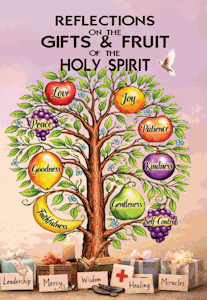
If you would like to learn more about the gifts of the Spirit, we encourage you to pick up our 32-page booklet, Reflections on the Gifts and Fruit of the Holy Spirit.